

Four Disciplines to Actually Execute Your Goals
Why even the clearest goals fail and how to fix it

Once you know what you want, execution should follow. Set the goal, make a plan, do the work. Simple.
Except it isn’t.
I’ve watched coaching clients nail their goals only to drown in their daily whirlwind.
I’ve consulted a leading digital bank that had a clear vision & strategy, but their management never executed because every minute was spent in meetings.
And I’ve done it myself: crystal clear on what matters, yet weeks pass without meaningful progress on the thing I said was most important. The goal sits there, untouched, while urgent emails and requests eat the day.
Most attention in business and in life, goes to the ‘what’: the strategy, the vision board, the New Year’s resolution. But the ‘how’ of execution? That’s where things fall apart.
Here’s what I’ve learned about the discipline of actually getting things done.
These ideas come from ‘The 4 Disciplines of Execution’ by McChesney, Covey, and Huling - a book I return to whenever I feel the whirlwind winning. Here’s my book note.
The whirlwind problem
There are two types of work in your life.
The first is the whirlwind: your day-to-day activities that keep things running. Responding to messages, attending meetings, maintaining relationships, putting out fires. This work is necessary. It’s often urgent…. and it will happily consume 100% of your time if you let it.
The second is breakthrough work: the few things that could genuinely change your trajectory. Getting that certification. Launching the project. Writing the book. Hiring the key person.
The problem? The whirlwind always feels more pressing. It screams louder. It has deadlines and expectations attached. The breakthrough sits quietly in the corner, important but never urgent, waiting for ‘when things calm down’.
They never calm down.
One executive I worked with had a clear goal: develop her leadership team so she could step back from operations. Important? Obviously. But every week, operational issues pulled her back in. Three months later, nothing had changed. She was still firefighting, still exhausted, still convinced she’d get to the leadership development ‘soon’.
The whirlwind had won.
The discipline of the wildly important
The first shift is brutal in its simplicity: focus on one wildly important goal at a time.
Not three priorities, not five strategic objectives. One.
This feels wrong. We're taught that ambitious people juggle multiple important things. But here's the math: without active protection, the whirlwind takes 100%. You have to carve out at least 20% for breakthrough work - and then refuse to fragment it. Split it across three goals and each gets scraps. Nothing moves.
How to pick one out of many seemingly important goals? Change the question from ‘what is most important’ to ‘what would be a breakthrough, something that would allow me to play the game at an entirely new level?’
The format matters too. A wildly important goal isn’t ‘improve leadership’ or ‘grow the business’. It’s specific and measurable: ‘Increase team autonomy score from 3.2 to 4.5 by June’ or ‘Launch the product with 100 paying customers by Q3’.
The format: From X to Y by when.
That civil servant I mentioned in a previous newsletter: his breakthrough wasn’t on any official priority list. It was getting certified as a mediator - something that would transform how he led complex negotiations. He set the one breakthrough goal, and protected 20% of his time to work on it. Within months, he was leading cross-departmental initiatives he’d thought were out of reach.
Acting on what you can actually influence
Here’s where most goal-setting goes wrong: we focus on outcomes we can’t directly control.
Revenue targets, election results, weight loss are typically lag measures. They tell you whether you won or lost, but only after the fact. Staring at them is like driving while only looking in the rearview mirror. You can formulate your one goal like it; but to reach it, you need metrics that you can act on.
Lead measures are different. They’re the activities you can directly influence that predict whether you’ll hit your goal.
If the lag measure is ‘lose 10kg’, the lead measures might be ‘exercise 30 minutes daily’ and ‘eat under 2000 calories’. If the lag measure is ‘double sales’, the lead measures might be ‘make 20 prospect calls per week’ and ‘follow up within 24 hours of every meeting’.
This isn’t revolutionary. But we rarely actually track lead measures with the same rigour we track outcomes.
Making progress visible
People play differently when they keep score themselves.
I’m not talking about a fancy dashboard a manager would use, nor quarterly reviews. A simple, visible scoreboard that shows at a glance to those who are executing (even if that’s just you): are we winning?
This works because progress is motivating. Small wins compound, but you need to see them. If your breakthrough goal lives only in a planning document you check monthly, it’s easy to let it drift.
I keep a simple tracker for my own wildly important goal: a single page showing my lead measures week by week. Nothing fancy. But that visibility creates a gentle accountability I’d otherwise avoid.
But even with that one breakthrough goal, lead measures, and a simple scoreboard, one piece is still missing.
The rhythm that makes it real
Disciplines one through three set up the game. But execution happens in discipline four: a regular cadence of accountability.
For teams, this means a short weekly session of 20-30 minutes, focused only on the wildly important goal, not the daily business of the whirlwind, and not general updates. Just: what did we commit to last week, did we do it, what will we commit to this week?
For individuals, it’s the same principle. A weekly moment where you account for your commitments, review what’s working, and decide on the one or two actions that will most move your lead measures.
I’ve experimented with this cadence myself. Every Sunday evening, I review my breakthrough goal: what did I commit to, did I do it, what’s the commitment for next week? (I’ve added a few more questions, here’s my weekly review template). It takes 15 minutes. But they’ve have moved more projects forward than any annual planning session could have.
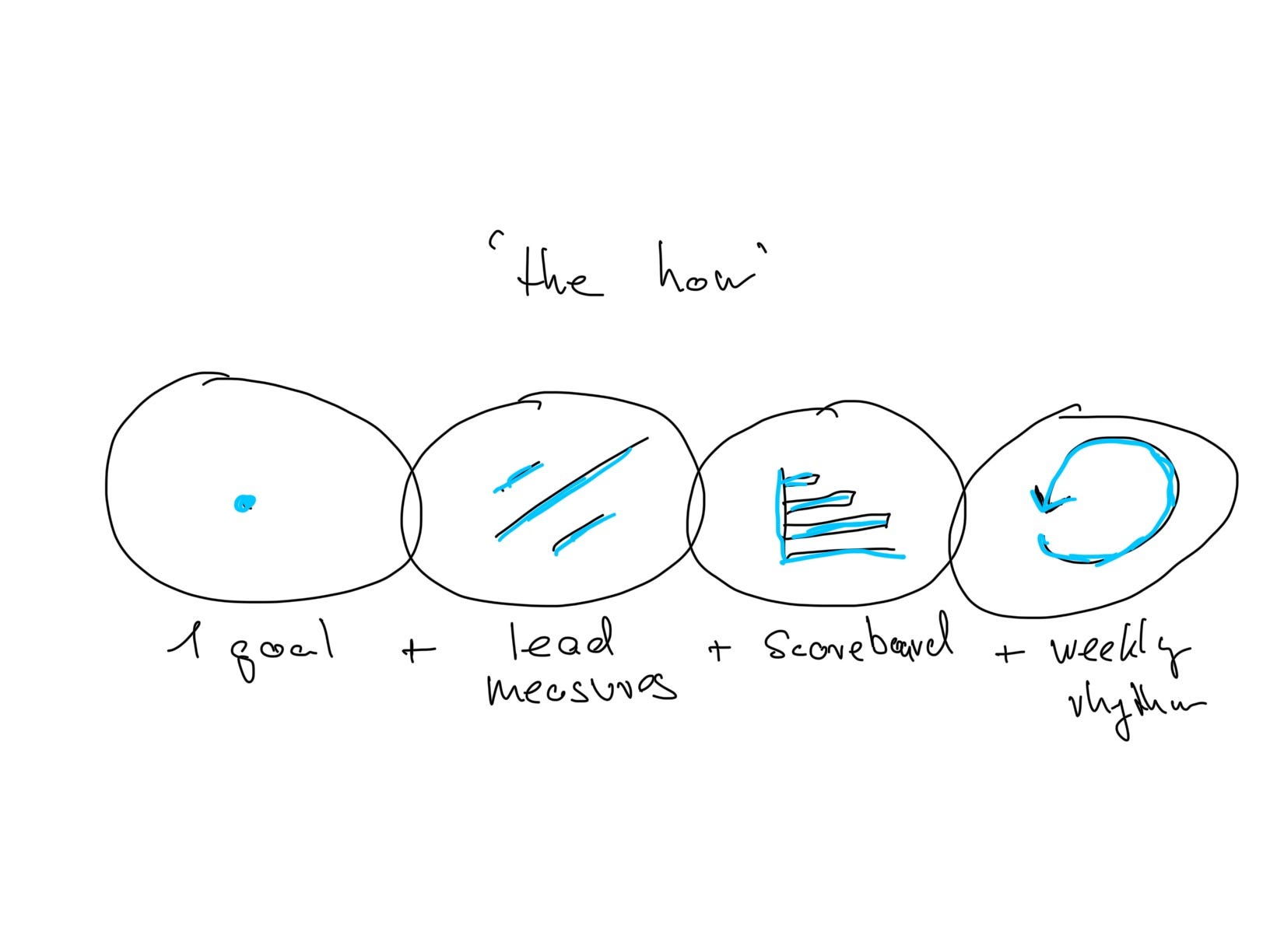
So here are the four disciplines:
Set a breakthrough aka. wildly important goal
Define lead measures
Create a simple scoreboard
Have a (weekly) cadence of accountability
And note how they work as a system, so if you skipped any, the house would fall:
Without a wildly important goal, there’s motion but no direction
Without lead measures, there’s effort but no leverage.
Without a scoreboard, there’s work but no feedback.
Without a cadence of accountability, there’s intention but no follow-through.
The main thing is to keep the main thing the main thing. These four disciplines are the closest thing I’ve seen to a system that makes it real.
Want help building this system for yourself? I run a 4-week focus sprint in March where we define your breakthrough goal, set your lead measures, and establish the weekly cadence that makes execution real. Apply here.