

Motivation Dies in the Middle
The structural flaw in every goal and 3 levers to avoid it

A coaching client told me last year: “I start strong. I always start strong. But somewhere around week six, I stop caring as much. I don’t quit. I just... do it worse.”
That line stuck with me because I recognized it instantly. From other clients and myself. The exercise plans that start with precision and decay into “good enough.” The goals that get serious attention in January and September, and coast through everything in between.
Most conversations about motivation focus on starting or finishing. Getting off the couch. Pushing through the last mile. But the real graveyard of goals isn’t at the beginning or the end.
It’s in the middle.
Why the middle is where standards die
Ayelet Fishbach, a behavioral scientist at the University of Chicago, studied this pattern in Get It Done. Her finding is clean and uncomfortable: our commitment to any goal is weakest in the middle.
It’s there, in the middle, that the psychological mechanics of motivation work against us most strongly.
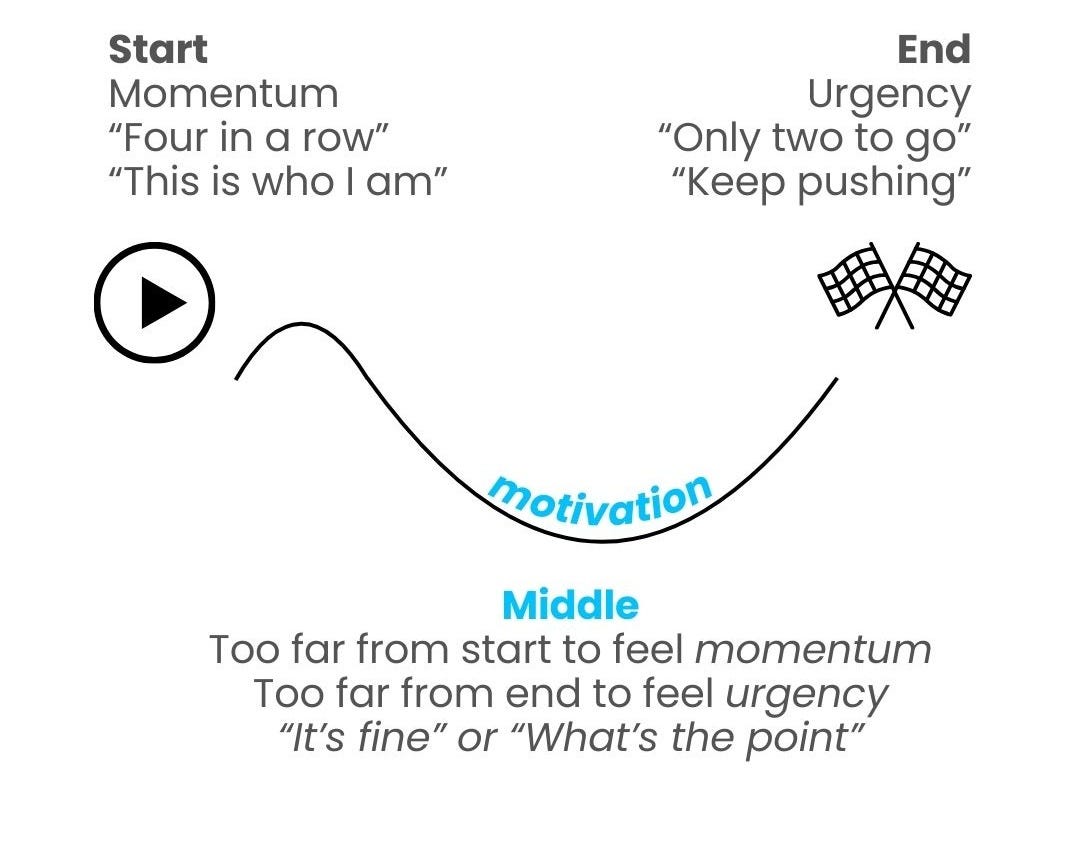
Fishbach calls it the small-area principle. We instinctively compare our progress to whichever reference point is smaller: what we’ve already done, or what’s left to do. Early on, “I’ve done 2 out of 10” feels like traction. Near the finish, “just 1 left” creates pull. But it doesn’t work in the middle: you’re too far from the start to feel momentum, too far from the end to feel urgency.
The result isn’t dramatic. You don’t necessarily throw in the towel. But you do cut corners. You lower the bar just enough to keep going without doing it right. The goal survives in name. The quality doesn’t.
Two lenses, one wrong default
Fishbach identifies two psychological lenses for evaluating progress, and most people default to the wrong one in the middle.
The first is consistency: looking back at what you’ve already accomplished. This signals commitment. “I’ve shown up four times, so clearly I care about this.” It reinforces identity and keeps you going.
The second is balance: looking forward at what’s still missing. This signals a gap. “I still have six sessions left, I need to keep pushing.” It creates urgency.
Neither lens is universally right. The flexible rule: when you’re early in a goal and still building commitment, look backward. Celebrate what you’ve done. But past the midpoint, it’s best to switch: look at what remains.
The middle is precisely where most of us use neither lens deliberately. We drift. We lose the anchors of progress and urgency.
Three structural fixes
I found the most useful insight from Fishbach’s research - and also the most forgiving is this: the fix isn’t motivational but structural. You don’t push harder through the middle. You redesign so the middle barely exists.
You can do that in three ways:
1) Shorten the cycle
A weekly goal has a shorter middle than a monthly one. A quarterly check-in has a shorter middle than an annual review. If your goal spans twelve weeks, break it into three four-week phases. Each phase gets its own beginning, middle, and end. The dangerous middle shrinks from weeks to days.
I tested this with a client who was struggling with a six-month strategic initiative. We restructured it into monthly sprints with discrete deliverables. Her words after three months: “I stopped coasting because there was nowhere to coast.”
2) Create fresh starts
Temporal landmarks (Monday, first of the month, a birthday, even lunch as a day-reset) can turn the middle of a long goal into a new beginning. The middle of a 12-week plan becomes “week 1 of phase two.” Fishbach’s research shows that these perceived fresh starts genuinely reset commitment. Our brains segment time naturally. Use that.
3) Switch the lens at midpoint
Before the midpoint: track what you’ve done. Build the identity of someone who follows through. After the midpoint: shift attention to what’s remaining. Let the shrinking gap pull you forward. You take advantage of the specific psychological mechanism (small-area comparison) that you need most at any point.
What this means if you lead others
If you manage a team or coach individuals, this pattern matters. The middle is where your people silently lower their standards without telling you or themselves. Where the project goes from “excellent” to “acceptable” without anyone noticing the shift.
Check-ins, milestones, and feedback matter most in the middle. Not at kickoff, where energy is high. Not before the deadline, where urgency does the work. In the middle, where neither force operates.
Look at your current goals. Where are you in the timeline?
If you’re in the middle, two questions:
Which lens am I using right now, backward or forward? Is it the right one for this stage?
And: how can I make this middle shorter?
Like this? Subscribe to get a 5-minute assessment for your personal focus profile + weekly tools