

The Cognitive Bias Running Your Week
And why knowing about it doesn't help

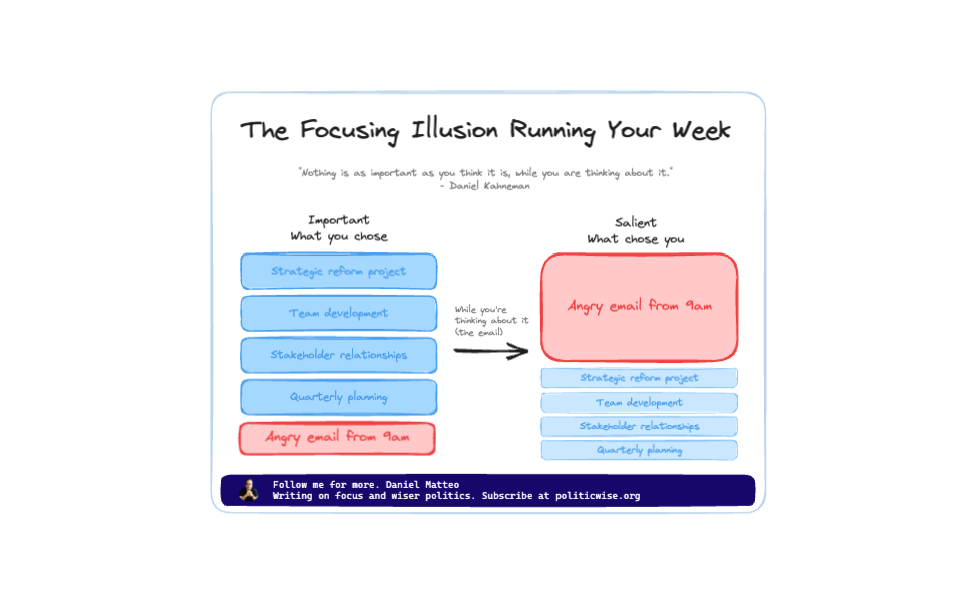
The most important thing on your mind right now is probably not the most important thing in your life.
You may think it is because you’re thinking about it.
Daniel Kahneman called this the focusing illusion, and when he was asked what single concept would most improve how people understand the world, this is the one he picked.
His formulation is blunt:
“Nothing in life is as important as you think it is, while you are thinking about it.”
That sentence sounds like from a fortune cookie until you watch it play out in your own week. The urgent email that arrived at 8:47am reshapes your entire morning. The angry constituent call drowns out the structural reform you said was your top priority for the week. The client who messages “Can we talk?” at lunchtime suddenly feels more urgent than the project you haven’t opened in three weeks.
None of these things became more important. They became more salient. And your brain treated salience as importance.
Why does this happen?
How does it affect the people around you?
Why doesn’t knowing about it fix it?
The loudest thing wins
One of the cleanest experiments in behavioural science goes like this. Researchers asked students two questions:
“How happy are you with your life?”
“How many dates did you have last month?”
When asked in that order, the answers were unrelated. Correlation near zero.
But when the dating question came first, the correlation jumped to 0.66. Thinking about their dating life made it the lens through which they judged everything else.
That’s the mechanism. Whatever you were just thinking about becomes disproportionately important. Not because it is, but because it’s occupying your attention.
I see this constantly in coaching. One client, a new product manager, came to me after six months in her role feeling like she was failing. She was responding to every request within hours, taking every meeting, reading every message. She told me her top priority was launching a new product. When I asked her to show me where her time actually went that month, the new product didn’t appear once. Not a single meeting, not one email thread, not an hour of focused work.
I don’t think she was lazy. I do think she was captured. Every incoming demand felt like the most important thing because it was the thing she was looking at. The loud stuff won every single morning, and the important stuff kept getting deferred to ‘next week.’
How it scales
The focusing illusion doesn’t stop at your calendar. It shapes teams and it shapes politics.
When a leader reacts to something, they signal importance to everyone around them. An executive who opens Monday’s meeting by flagging a competitor’s press release has just told the room: this is what matters. The team recalibrates. By Wednesday, three people are working on a response to something that, structurally, changes nothing about the company’s position. Meanwhile, the initiative that would actually shift the business sits untouched on a shared drive.
This is the illusion operating at organizational scale. The leader’s attention becomes the team’s priority list.
In politics, the mechanism is even more visible. Outrage cycles run on the focusing illusion. The angriest voices in a town hall feel like the majority because they’re the ones you hear. A single viral incident can displace months of policy work because it monopolizes public attention. Media amplifies this: whatever gets covered most feels most important to voters, politicians, and journalists alike. The spiral feeds itself.
Kahneman made a point about adaptation that complicates things further. We don’t consider, when planning for the future, that we’ll stop paying attention to a thing. The crisis that consumes you today will fade. The structural work you keep postponing won’t do itself. But in the moment, you can’t feel that. The loud thing fills the frame completely, and the quiet thing disappears.
I remember working with a board that started receiving a wave of negative emails about an important initiative. Within hours, every meeting was about damage control. The work was on pause. It took a few days to realize: only the complaints were landing in their inbox. The positive responses were there, but subtle, and going somewhere else. We thought we were in a crisis, but really we were staring at a skewed sample that had colonized everyone’s attention.
Politicians who govern by reacting to what’s loudest are running on a cognitive bias. The same is true for consultants who let client emergencies crowd out their own business development, or NGO executives who spend their weeks firefighting donor requests instead of building the programs donors supposedly funded.
Why knowing doesn’t fix it - and what to do
Here’s where it gets uncomfortable. Kahneman spent decades studying cognitive biases, and he was candid: knowing about a bias doesn’t make you immune to it. You can understand the focusing illusion perfectly and still fall for it on Tuesday morning.
Winifred Gallagher, in her book Rapt, frames the positive version of this: your life is the sum of what you focus on. If that’s true, then the management of your attention is the single highest-leverage skill you can develop.
But “manage your attention better” is advice that crumbles on contact with a real work week. You need something external. A system that compares what felt urgent against what actually moved forward. A structure that shows the gap between where your attention went and where you said it should go.
The client I mentioned earlier started doing a weekly review: ten minutes, two columns. Left column: what felt most important this week. Right column: what I actually spent time on. The first time she did it, the mismatch startled her. Launching the new product appeared in the left column. It didn’t appear in the right column at all. Three weeks in a row.
The review is retrospective. You also need something looking forward. Any structure that forces you to name your priorities before the noise arrives works, because it pre-loads the right thing into your attention.
Oliver Burkeman’s 3-3-3 method does this and I like it for its simplicity.
Before your day starts, name:
3 hours for your most important project,
3 shorter priority tasks, and
3 maintenance items.
The act of writing it down makes the important thing salient before the inbox gets a chance to. The focusing illusion still runs. But now it’s running on your terms.
These two exercises work. But they’re weekly patches. They catch the distortion after it fires or pre-load the right input before it fires. What they don’t tell you is where your focus is structurally strong and where it keeps breaking down. The same leader who nails the 3-3-3 every morning might consistently lose her attention to conflict avoidance by Thursday. A different leader might plan well but lack the filtering strength to protect the plan from interruption. The pattern underneath the week matters more than any single week.