

What 50+ leaders taught me about getting things done
Three patterns that have nothing to do with discipline

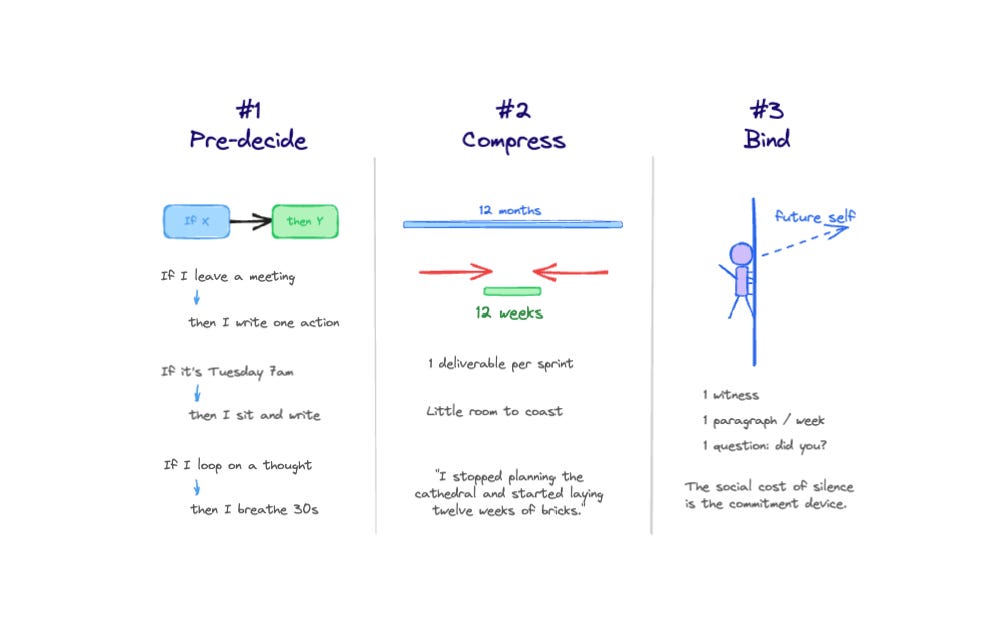
I’ve coached over fifty leaders across consulting, politics and NGOs specifically on moving ahead on their biggest priority: typically the most important thing on their plate, but the least urgent.
These leaders share a profile. They have high autonomy, high responsibility, and low institutional guidance, i.e. nobody briefs them, nobody manages their agenda, nobody asks what they’re working on this quarter. Beyond that, the ones who consistently get things done share almost nothing in common on the surface. Different industries, different personalities, different levels of ambition.
But underneath, three structural patterns kept showing up. Three things these people did to consistently execute on their priorities.
I started cataloguing them.
The problem was never knowledge: everyone had a plan and priorities. But before adopting the patterns, theirs plans sat there, perfectly clear, but also perfectly postponed.
Today I want to share those three patterns, because I think adopting just one of these can already make a real difference:
Why pre-deciding beats planning
Why shorter time horizons force better execution
Why the smallest commitment to another person outperforms the biggest promise to yourself.
To get meaningful work done consistently, you need structures that make action the default.
Here’s what I’ve seen work:
1. Pre-decide, don’t just plan
The psychologist Peter Gollwitzer has spent three decades studying why people fail to act on their intentions. His core finding: when people specify the when, where, and how of an intended action in advance, they follow through two to three times more often.
He calls these “implementation intentions,” and the format is simple:
“If [SITUATION], I will do [BEHAVIOUR]”
The mechanism is what makes this interesting. You’re handing control of the action to a situational cue instead of relying on a fresh decision in the moment. The environment triggers the behaviour. You’ve already decided.
Let me make this real with three versions I’ve seen work:
The Tuesday morning writer. A consultant client kept telling me she’d “find time” to work on her new product offer. Months passed, but nothing. Then we changed one thing: Tuesday, 7 to 9am, at the kitchen table, phone in another room. She told her partner that’s when she writes. Three weeks later, a first version existed and she had sent the offer to her first prospect. She knew for months what needed to happen - “but knowing is not enough” as Bruce Lee would say. Only once she decided a specific behaviour in advance (and communicated it to her partner and me), did she execute consistently.
The Friday afternoon reviewer. An NGO executive was drowning in reactive work and never touched her strategic priorities. We linked a weekly review to an existing habit: every Friday afternoon, right after her standing team check-in, she opens a single document and answers two questions. What did I move forward this week on my leverage project? What’s the one action for next week? The ritual takes eight minutes. It’s been running for seven months.
Lack of motivation was never the issue for the consultant or the NGO exec; what they were missing was a pre-made decision attached to a specific moment,.. Once they set an implementation intention, they moved ahead on their priorities.
I use a version of this myself: when I notice my thoughts running in circles, looping on the same worry or decision without moving it forward, I stop and take a few conscious five-second inhales and exhales. The moment I catch myself revisiting the same thought for the third time, the breathing kicks in. It doesn’t solve the problem. But it breaks the pattern long enough to choose what to do next instead of letting the stress choose for me.
2. Compress the time horizon
Brian Moran’s 12 Week Year framework rests on one observation: most organizations and individuals produce a disproportionate share of their results in the final stretch before a deadline. The annual planning cycle creates a false sense of spaciousness that kills urgency for the first nine months.
The fix: treat twelve weeks as a full year, with one to three goals per cycle.
Three ways I’ve seen leaders adopt this:
The policy sprint. A political staffer was running an 18-month legislative reform and treating the timeline as one long runway. We broke it into six 12-week sprints, each with one deliverable. First sprint: stakeholder map. Second: draft framework. His phrase stuck with me: “I stopped planning the cathedral and started laying twelve weeks of bricks.” The reform passed.
The quarterly practice builder. An independent consultant committed to building a referral system but kept pushing it behind client work. We carved out a 12-week cycle focused on exactly one metric: conversations with potential referral partners per week. Not revenue. Not “build the system.” Just conversations. She had 34 by week twelve. The system built itself from the relationships.
The fundraising sprint. An NGO director had spent two years saying she needed to diversify funding sources. The goal was too big and too shapeless to start. We set one 12-week target: five conversations with foundations she’d never approached. Not applications. Conversations. After ten weeks she’d had seven, and two turned into proposals. The pipeline she’d been planning for two years got built in a quarter.
The principle underneath all three: a shorter horizon forces you to choose less and finish more. It also solves another problem I wrote about recently: motivation dies in the middle. When your cycle is twelve weeks instead of twelve months, the middle shrinks from months to days. There’s less space to coast.
3. Bind your future self
Thomas Schelling won a Nobel Prize for studying how nations make credible commitments. His insight applies to individuals: you can strengthen your position by deliberately cutting off your own options (like a general would burn down a bridge behind their army). The philosopher Jon Elster extended this with what he called the Ulysses strategy, after Ulysses who had his crew tie him to the mast so he couldn’t steer toward the Sirens.
Think of a country’s constitution: it works because it constrains future decision-making in advance. It binds a population’s future self to principles chosen in a calmer moment.
Personal commitment devices do the same thing at the scale of a single week.
Three examples:
The one-paragraph update. An NGO executive committed to sending a weekly one-paragraph progress update on her top-priority project to three board members. She could have stopped any time, but the social cost of going silent was enough friction to keep her moving. Four months later, the project she’d been “working on” for two years was done.
The shared calendar block. Two consultants in different cities created a shared two-hour “deep work” block every Wednesday morning. Same time, same calendar entry, visible to both. Neither checks in during the block. But after the block, they each send one line on Slack: what they worked on. Missing the block is technically costless. But leaving the message blank in front of someone doing the same work feels worse than two hours of focused effort. The block hasn’t been missed in three months - in an industry that is notorious for reacting in-the-moment to any-and-all client (or partner) requests.
The paired accountability call. Two advisors I work with started a ten-minute call every Monday morning. Each states their one priority for the week. The following Monday, they report. No coaching. No advice. Just the question: did you do it? Both have told me separately that it’s the most effective structure in their professional life. The call costs them ten minutes. The cost of showing up empty-handed is what makes it work.
I built a small tool based on these patterns (thanks Claude Code!). You name one action, one witness, and one deadline. And on Friday, it asks you: did you do it?