Not All Generalists Are Lost
Four Types. Four Organizing Principles. One Question

Most advice about generalists gets it wrong. It either celebrates being a jack-of-all-trades (which is just a nice way of saying “unfocused”) or tells you to pick a lane. Neither helps if you’re someone with genuine range who wants that range to mean something.
I made the case that there’s a difference between a generalist by default and a generalist by design. A generalist by default has many interests that don’t add up. A generalist by design has an organizing principle that turns diversity into depth. A couple of you replied (thanks - always appreciate the feedback!) with different versions of the same question:
“OK, but what does a generalist by design actually look like?”
Fair question. I don’t think the answer is one thing. It’s four.
I’ll share:
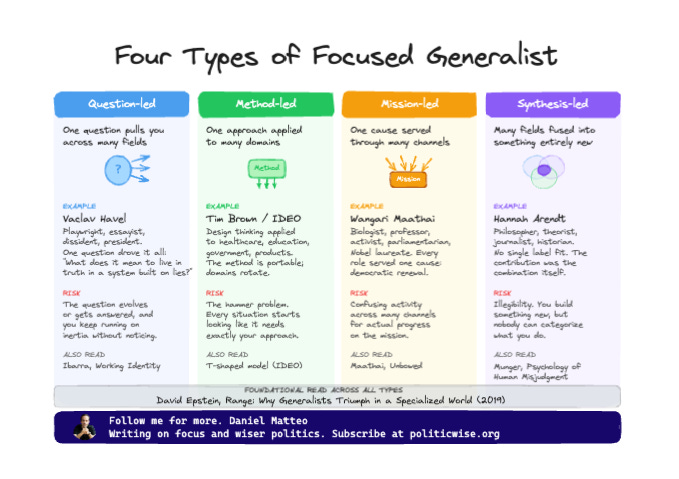
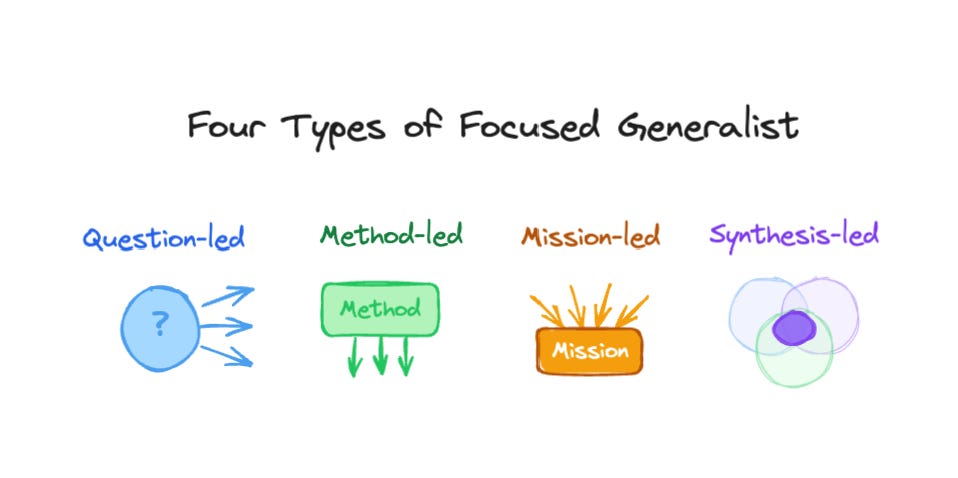
Four distinct types of focused generalist, each with a different organizing principle
A real person who embodied each type (and what we can learn from their path)
The specific risk each type carries, so you know what to watch for
Why this matters now
David Epstein, in his book Range, makes a distinction between “kind” and “wicked” learning environments. Kind environments have clear rules, repeating patterns, and immediate feedback. Think of chess or golf; specialists thrive here.
Wicked environments have unclear rules, delayed feedback, and constantly shifting conditions. Politics is a wicked environment. So is leading any fairly complex organization. And so, increasingly, is every field being reshaped by AI, where the rules are being rewritten faster than anyone can master them.
Epstein found that the highest-impact inventors at 3M were not pure specialists or pure generalists. They were what the researchers called “polymaths”, i.e. people with breadth across many domains and at least one area of real depth. Breadth alone didn’t cut it. Depth alone didn’t cut it. The combination did, because it was organized.
That’s the key word: organized. And the organizing principle is what separates the four types.
1) Question-led: “I follow one question across fields”
Václav Havel was a playwright, then an essayist, then a dissident, then the president of Czechoslovakia, and later the Czech Republic. From outside, this looks like a wild career arc. From inside, it was one straight line.
The line was a question: What does it mean to live the truth under a system built on lies?
Every domain Havel entered was a new way of pursuing that question. He didn’t plan to become a politician. The question pulled him there. This is what Herminia Ibarra, professor at London Business School, found in her work on “working identity”: the organizing principle often becomes visible after the fact, not before. You don’t start with the thread. You discover it by looking back at what kept pulling you forward.
The risk for the question-led generalist: the question evolves or gets answered, and you keep running on inertia without noticing.
2) Method-led: “I apply one approach everywhere”
Tim Brown built IDEO into one of the most influential design firms in the world. The method was design thinking: empathize, define, ideate, prototype, test. The domains kept rotating: healthcare, education, government services, consumer products. The method stayed constant.
You might know the “T-shaped professional” idea from design and consulting circles: broad general knowledge across many fields, with one deep vertical of specialization. The method-led generalist is the person who gives the T its spine. The breadth makes sense because the method is portable.
The risk: the hammer problem. When your method is powerful, every situation starts looking like it needs exactly your approach. It takes discipline to recognize when a problem doesn’t fit your framework, especially when the framework has worked everywhere else.
3) Mission-led: “I serve one cause through many channels”
Wangari Maathai started as a biologist. She became the first woman in East Africa to earn a doctorate, then a professor at the University of Nairobi. Then she founded the Green Belt Movement and mobilized thousands of women to plant over 30 million trees across Kenya. Then she was elected to parliament with 98% of the vote. Then she won the Nobel Peace Prize.
Read that list of roles quickly and it sounds scattered. Read it slowly and you see one mission running through every single one: environmental and democratic renewal in Kenya, from the ground up.
The mission-led generalist acquires whatever capabilities the mission requires. I don’t think Maathai set out to become a politician. She became one because her mission demanded it. The channels changed, the mission never did.
The risk: confusing activity across many channels for actual progress on the mission. Being busy in five domains feels productive. But if the mission isn’t advancing, the breadth is a distraction dressed up as impact.
Synthesis-led: “I combine fields into something new”
Hannah Arendt was a philosopher, a political theorist, a journalist, a historian. Ask which one she really was and you’ll get a different answer depending on who you ask. That’s the point. None of those labels captured her contribution, because the contribution lived in the combination. She fused philosophy, political theory, reportage, and historical analysis into something none of those fields fully claimed. The Origins of Totalitarianism doesn’t belong to any single discipline. It created its own.
Charlie Munger called this a “latticework of mental models”: the insight that real-world judgment comes from pulling lenses across psychology, economics, physics, biology, and history. The value is in meaningfully combining them.
If I’m honest, I think this is where I land. My work keeps trying to say one thing: that personal focus and political agency are the same muscle. That idea doesn’t live neatly in any existing field, which is exactly why it’s been so hard to explain at dinner parties.
The risk for this type is illegibility. You’re building something genuinely new, but nobody can easily categorize what you do. Including, sometimes, yourself.
One more variable: sequencing
Beyond the organizing principle, there’s the question of timing. Some focused generalists run multiple streams in parallel (the portfolio career). Others move through domains one at a time, each building on the last. And some converge gradually: the early career looks scattered, the late career looks focused.
Ibarra’s research suggests that the convergent path is more common than we think. The thread was always there. You just couldn’t see it yet.
Here’s the real question.
Not “which type am I?” That’s useful but secondary.
The deeper question: Can you name the thread?
Can you articulate the question, method, mission, or synthesis that connects what you’re doing? And if you can’t yet, what would help you see it?
I’ve found that the thread often becomes visible when you look at what you pay attention to, not always what you do. What you keep returning to when nobody’s watching. What you can’t stop thinking about.
Here’s what I’ve learned from coaching people through this: most of us can identify our type fairly quickly. The harder question is whether our focus strengths actually match it. A mission-led generalist with weak filtering focus will drown in activity. A synthesis-led generalist who can’t sustain deep concentration will never get the synthesis to hold.
The Focus Score is a short diagnostic I built that maps your focus strengths and weaknesses across four dimensions.
Subscribe below and I’ll send it to you.